Cambodia by Henry Kamm
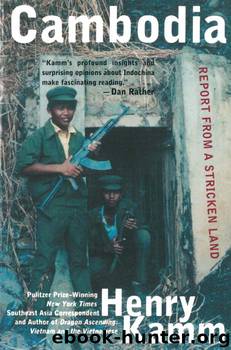
Author:Henry Kamm [Kamm, Henry]
Language: eng
Format: epub
ISBN: 978-1-61145-584-7
Publisher: Skyhorse Publishing
Published: 2011-01-09T16:00:00+00:00
11
“The Cambodian No Longer Exists”: 1975-1979
CAMBODIA’S LONGEST NIGHT began on the morning of April 17, 1975. Gradually the Khmer Rouge guns and rocket launchers, which had continued to hail death and fire onto the defenseless city of Phnom Penh through the night and into morning, fell silent. The longtime residents of the capital called their children inside and locked the doors. The majority of Phnom Penh’s people at the end of the five-year war, the countless refugees from the zones of fighting who were not favored with the luxury of fixed homes, clustered around pagodas, schools, ministries, and other public buildings. Soldiers of the government army ditched their weapons and blended into the population. The few remaining foreigners — diplomats, journalists, aid workers — gathered in the Hotel Le Phnom, which they had declared a neutral safety zone under Red Cross auspices, or in the spacious grounds of the French embassy. The city waited nervously, its people trembling when an occasional burst of small-arms fire crackled nearby.
And then the Khmers Rouges came. Silently marching in single file, dressed in black, shod with sandals cut from tires, arms, mainly Chinese-made or captured American rifles, at the ready. What struck the people of Phnom Penh most, according to firsthand accounts of those who escaped, which I began gathering shortly after the event, were the youth of the conquering soldiers and their fierce, unsmiling, automatonlike demeanor. Their grimness was frightening. Whatever fears the citizens may have harbored of the Khmers Rouges before, their coming meant to many Cambodians the end of the five years of war, and that was cause enough for gladness. That a Communist regime was arriving was certain, and to most Cambodians no cause for rejoicing. But even to them it meant not merely a future under a regime of unforgiving rigor but also an end to the violent lawlessness and corruption that the Lon Nol government and the war had visited on Cambodians.
But on that very first day of what was so romantically called the “liberation,” came the stunning order to all to evacuate the city. The old and the young, the healthy and the invalid, those who had secretly wished for the victory of the Khmers Rouges as well as those who until the last moment had served the Lon Nol regime, whatever their beliefs — all were driven out. For weeks the roads of Cambodia were clogged with masses of wretched men, women, and children heading away from home, far from where they wished to be, from where they wanted to begin their lives anew in a time of newfound peace. The new rulers drove them to distant places, whose principal attribute was as often as not unsuitability to sustain life.
Some were spared the long march. Cabinet ministers and generals who failed to escape did not survive the “liberation” long enough to join the exodus. They were summoned to appear in front of the Information Ministry, and it is presumed that those who did — they included Lon Non and Long Boret — were killed on the same day, without even a sham trial.
Download
This site does not store any files on its server. We only index and link to content provided by other sites. Please contact the content providers to delete copyright contents if any and email us, we'll remove relevant links or contents immediately.
| Africa | Americas |
| Arctic & Antarctica | Asia |
| Australia & Oceania | Europe |
| Middle East | Russia |
| United States | World |
| Ancient Civilizations | Military |
| Historical Study & Educational Resources |
The Sympathizer by Viet Thanh Nguyen(4390)
The Rape of Nanking by Iris Chang(4213)
World without end by Ken Follett(3477)
Ants Among Elephants by Sujatha Gidla(3467)
Blood and Sand by Alex Von Tunzelmann(3203)
Japanese Design by Patricia J. Graham(3174)
The Queen of Nothing by Holly Black(2599)
City of Djinns: a year in Delhi by William Dalrymple(2555)
Foreign Devils on the Silk Road: The Search for the Lost Treasures of Central Asia by Peter Hopkirk(2464)
India's Ancient Past by R.S. Sharma(2454)
Inglorious Empire by Shashi Tharoor(2438)
Tokyo by Rob Goss(2429)
In Order to Live: A North Korean Girl's Journey to Freedom by Yeonmi Park(2392)
Tokyo Geek's Guide: Manga, Anime, Gaming, Cosplay, Toys, Idols & More - The Ultimate Guide to Japan's Otaku Culture by Simone Gianni(2373)
India's biggest cover-up by Dhar Anuj(2354)
The Great Game: On Secret Service in High Asia by Peter Hopkirk(2349)
Goodbye Madame Butterfly(2253)
Batik by Rudolf Smend(2184)
Living Silence in Burma by Christina Fink(2071)
